Buying guide7 min readUpdated
Clinic Queue Management in India: How to Calm a Crowded Waiting Room
Tokens on WhatsApp, a TV that shows the current number, and a front desk that is not answering 'how long?' all day.
On this page
Evening OPD in a busy Indian clinic looks the same everywhere. The room is full, the receptionist is on the phone, and every few minutes someone asks 'how many more?'. The doctor feels the pressure, and patients who could have waited outside stay packed inside.
This guide explains the common ways clinics run their queue, what each one costs in time and money, and how TOKENN moves the queue to WhatsApp. If you also need patient records and prescriptions, read our clinic OPD software guide.
The three ways clinics run a queue today
Most clinics use one of three methods. Each works up to a point, and each breaks in a different way when the day gets busy.
| Method | What the patient sees | Where it breaks |
|---|---|---|
| Paper token or register | A number on a slip, and the doctor's door | Patients cannot tell how long the wait is, so they stay and ask |
| Token display machine | A number on a screen in the waiting room | Patients must stay in the room to see the screen; no update on their phone |
| WhatsApp token (TOKENN) | Token, expected wait and live updates on WhatsApp, plus a TV display | Needs internet at the clinic; walk-ins without a phone get a token from reception |
What good queue software must do
Whatever you choose, check it does these jobs without extra work for reception:
- Give a token in seconds, to patients with and without a smartphone
- Tell each patient their expected wait, and update it as the queue moves
- Remind the patient when they are close, so they can wait outside or nearby
- Let reception call the next token with one tap
- Show the current token on a screen in the waiting room
- Handle both walk-ins and timed appointments for doctors who give slots
- Reply in the language your patients type in
How a WhatsApp queue works, step by step
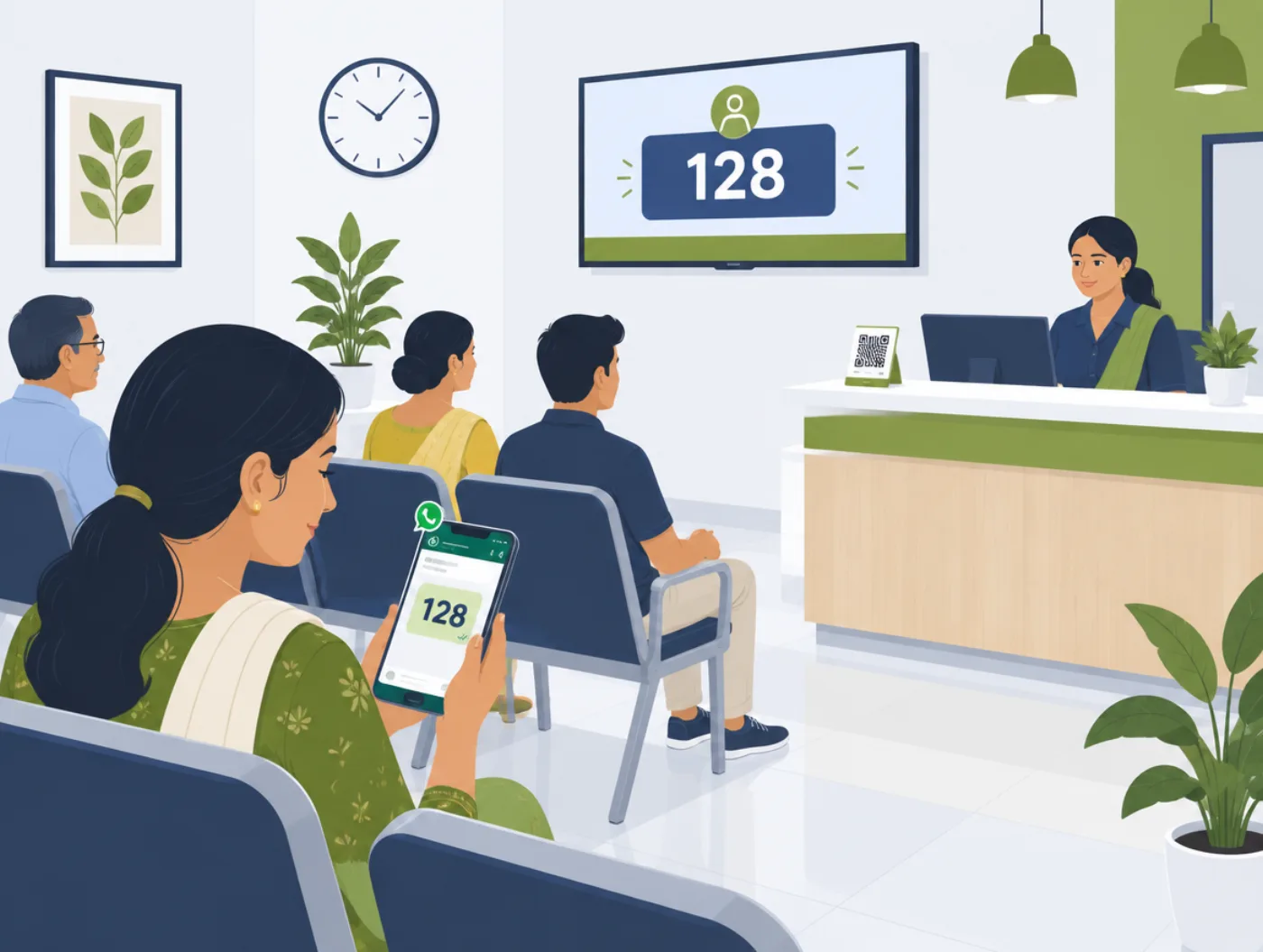
The clinic prints a QR code for the front desk. A patient scans it or sends a WhatsApp message and gets a token with the expected wait. There is no app to install and no sign-up.
As the doctor sees patients, the queue moves and each patient gets updates on WhatsApp. With TOKENN, the patient gets a 'two ahead' reminder, so they can step out for tea and come back in time. Any Android TV or tablet in the waiting room shows and announces the current token.
Patients who do not use WhatsApp are not left out. Reception gives them a token in two taps, and they join the same queue as everyone else.
Queue first, or full clinic software first?
If your daily pain is the crowd and the questions, fix the queue first. It is quick to set up and patients feel the change on the first day.
If your pain is records, prescriptions and follow-ups, start with Clinic OPD. Many clinics use both: TOKENN for the waiting room and Clinic OPD for the medical record. If the phone is the problem, see our guide on missed calls.
| Your main problem | Start with | Why |
|---|---|---|
| Crowded waiting room, 'how long?' questions | TOKENN | Tokens and live wait updates on WhatsApp |
| Patients forget their appointment | Clinic OPD | Online booking and SMS or WhatsApp reminders |
| Old prescriptions are hard to find | Clinic OPD | Every visit and prescription in the patient record |
| Both | Both | TOKENN runs the queue; Clinic OPD keeps the records |
What TOKENN costs
TOKENN costs ₹1 per patient token or appointment. The starter pack is 150 tokens for ₹149. There is no monthly fee, and tokens do not expire. Current packs are listed on tokenn.live.
It understands messages the way patients actually type them, including mixed-language messages.
Checklist before you buy
Tick these off in the demo. If any is missing, ask why.
- Patients get a token without installing an app
- Walk-in patients without a smartphone join the same queue
- Patients see their expected wait and get a reminder when close
- Reception calls the next token with one tap
- Any TV or tablet in the room can show the current token
- The price per patient is clear, with no surprise monthly fee
Questions to ask any seller
These work for any software company, not only Cyberzio.
- 01What does a patient without a smartphone do?
- 02Does the patient get a reminder before their turn, or only a token number?
- 03Can doctors with fixed timings take appointments in the same system?
- 04Which languages does it reply in?
- 05What screen do I need for the waiting room, and what does it cost?
- 06Is there a monthly fee, or do I pay per patient?